
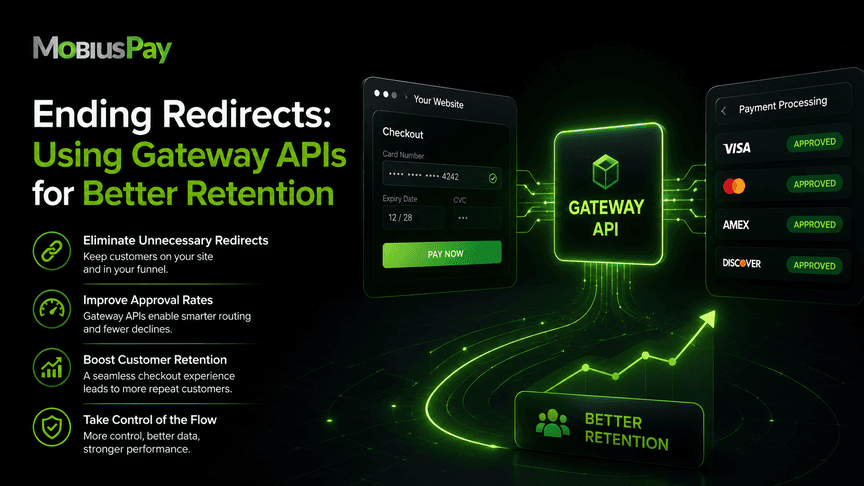
Ending Redirects: Using Gateway APIs for Better Retention
When it comes to high-risk businesses, ensuring you do not lose the user through a janky experience is a priority. You work to create traffic and make sure your funnel is optimal, all with the end goal of getting to the purchase experience. But then, at that critical moment, the user goes somewhere else. That is a redirect. And that is not good.
Redirecting a user to a third-party payment page is no good for the digital experience. It breaks focus, it confuses customers through misaligned branding, and it introduces a moment of hesitation. For high-risk merchants, where consumer trust is already fragile, that split-second pause can be the difference between a completed transaction and an abandoned cart.
So what is the solution? How can we course correct?
The solution lies in the architecture of your payment gateway. By leveraging the advanced API capabilities of gateways like ours, merchants can move away from clunky redirects and embrace embedded payments.
In this article, we will break down exactly how you can eliminate this critical misstep.
Step 1: Leverage the API Connection
To stop the redirect, you first need to understand the mechanics of how data travels.
Most basic merchant setups rely on a Hosted Payment Page. This is the method where your site hands the customer off to a secure, third-party URL to enter their credit card numbers. It is safe, but it is also a conversion killer. It tells the customer they are leaving your environment. And that’s no way to earn any trust.
There is a better alternative. It’s called Direct Post API.
Think of Direct Post API as a redirect that sends a customer to a different building to pay their bill. An API allows you to bring the cash register right to their table. So they don’t leave.
When you utilize the gateway’s API, your website collects the payment information and sends it to the processor in the background. The user hits "Buy Now" and the page simply loads a success message. The URL in their browser bar never changes. They never see a generic bank logo that presents a company they’ve never heard of. They stay immersed in your brand experience from start to finish. There’s no break in trust.
This does require a developer to hook up the connections between your shopping cart and the gateway.
However, for a high-risk business aiming for retention (aren’t we all?), this development cost can pay for itself by stopping the break in your sales funnel.
Here is the second step. This is crucial because it addresses the number one reason merchants are afraid to leave redirects: security liability.
Step 2: Solve the Security Fear with Tokenization
The main reason merchants cling to redirects is fear. The thought process is simple: "If I collect the credit card data on my own site, I am responsible for storing it. If I get hacked, I am finished."
That used to be true. But not so much anymore (we’ll explain).
To get the improved experience without the liability, you must utilize Client-Side Tokenization. This feature is built into our gateway and acts as a shield between your customer’s data and your server.
Here is how you execute this step:
Implement the Script: Your developer adds a small piece of code from the gateway (often referred to as client-side encryption or "Collect.js") to your checkout page.
Intercept the Data: When the customer types in their card number, that data does not go to your server. It is sent directly from the customer's browser to the gateway vault.
Exchange for a Token: the gateway instantly sends back a "token", a random string of characters that represents the card but has no value to a hacker.
Process the Sale: Your site finishes the transaction using that token.
And just like that, your servers never actually touch the raw credit card numbers. You reduce your PCI compliance scope significantly, yet your customer still sees seamless branding all the way to the checkout form.
Step 3: Optimize the Interface for Speed
Now that you have total control over the look and feel of your checkout page, it's time to satisfy that need for speed.
When you use a redirect, your customers are subjected to that company’s design. Their page might ask for unnecessary information. It might not look good on mobile devices. It almost certainly will not match your brand's color scheme. The list goes on.
With an API-driven checkout that is your brand, you drive the user journey. Here is how to use that control to increase speed:
Remove the Fluff: Only ask for what is strictly necessary to process the card. If you are selling a digital subscription, do not force the user to fill out shipping fields. This is a huge mistake we see happening all the time. Make the experience succinct.
Single-Page Experience: Keep the payment form on the same page as the product selection. Do not make the user click "Next" three times to find the credit card field. Every time they click, it’s an opportunity for them to re-evaluate, or even get distracted.
Mobile First: High-risk traffic is predominantly mobile. Because you control the code, you can ensure the credit card field brings up the correct numeric keypad on smartphones automatically.
By removing these barriers that cause second-guessing, you expedite the buyer experience.
Step 4: Drive Revenue with One-Click Upsells
The real magic of the API approach happens after the first sale. Because you implemented tokenization in Step 2, you are not just processing a transaction. You are creating a secure, reusable ID for that customer. Yep, one click upsells are now easily possible for your business.
This is due to you now having the MobiusPay Gateway experience called Customer Vault.
When you were redirecting, your customer had to re-enter information to upgrade or buy an add-on. That was a massive friction point.
With this token-based setup, you can offer "One-Click Upsells” instead.
You can now present an add-on or a premium upgrade. Since the gateway already recognizes their token, they can approve the purchase with a single click. No typing. No searching for the wallet.
You turn a one-time buyer into a higher-value customer instantly. This is the ultimate goal of embedded payments: removing the barriers between the customer’s desire and your revenue.
Conclusion
In the high-risk industry, every piece of conversion experiences matter. Losing an excited customer simply because of a redirect page load is something you can’t afford.
By switching to an API-driven gateway experience, you create a more conversion-oriented checkout process. You own the design and function.
At MobiusPay, we specialize in helping businesses maximize the power of our gateway. We are here to ensure your technology supports your hustle, rather than getting in its way.
Related Articles
Stop Fraud Without Losing Sales: High-Risk Checkout Tips That Work
Optimize your checkout for high-risk payments. Strike the right balance between fraud prevention and conversion to reduce chargebacks without losing real customers.
The Silent Revenue Killer: AI Card Testing
In the high-risk industry, AI card testing is simple in theory but devastating in volume.
Best Payment Gateway Options for Adult Websites in 2026
Most payment gateways will not touch adult businesses. Here are the gateway options that work, what to look for, and which features matter most for adult merchants.