
How to Securely Store Customer Credit Card Information
Repeat customers do not want to type their card number every time, and your subscription billing cannot run without a card on file. Today’s world is one of convenience at the forefront. If your business creates any sort of friction, you risk some potential customers falling off.
So the question is: how do we store customer credit card information without creating a breach or a compliance nightmare?
The answer isn’t all that complicated: store as little as possible, tokenize the rest, and let systems built for card data carry the risk.
But alas, if only things were that simple. Let’s explore the deeper complexities you should better understand when it comes to securing customer credit card information while appeasing a consumer’s need for convenience.
Key Takeaways
• You may store the card number, expiration date, and cardholder name if they are protected to PCI DSS standards. You may never store the CVV security code, PIN, or full magnetic stripe data after authorization, under any circumstances.
• PCI DSS 4.0 is now fully in effect, and its requirements apply to every business that stores, processes, or transmits card data, regardless of size.
• Tokenization is the practical answer for most businesses: the card number lives in your payment provider’s vault and your systems keep only a useless-if-stolen token.
• Card network rules also require cardholder consent for stored credentials and proper flagging of merchant-initiated charges.
• Storing less card data shrinks your PCI scope, your breach exposure, and your compliance workload all at once.
First: what you can and cannot store
The card networks and PCI DSS draw a hard line through card data.
• Allowed with protection: the primary account number (PAN), cardholder name, expiration date, and service code. The PAN must be encrypted or otherwise rendered unreadable everywhere it is stored, and masked whenever it is displayed.
• Never storable after authorization: the CVV or CVC security code, PIN and PIN blocks, and full track data from the stripe or chip. There is no compliant way to keep these, encrypted or not.
That second list surprises people. A saved CVV "for convenience" is an automatic compliance failure and a liability magnet, no matter how well you encrypt it.
Meet the standard: PCI DSS applies to you
PCI DSS is the card industry’s security standard, and version 4.0’s full requirement set has been mandatory since March 31, 2025. If card data touches your business, the standard applies; company size only changes how you validate, not whether you comply. The core obligations for stored data include strong cryptography for the PAN, strict access controls on a need-to-know basis, logging and monitoring of every touch, quarterly scans, and a data retention policy that deletes card data the moment the business reason expires. Our overview of PCI DSS 4.0 covers what changed in the current version, and our PCI compliance page explains how compliance levels work by transaction volume.
The smart move: do not store cards at all. Tokenize.
For most merchants, the winning strategy is to keep raw card numbers out of your systems entirely
• Collect card data through your gateway’s hosted fields or checkout, so the number goes straight from the customer’s browser to the payment provider.
• The provider stores the card in its PCI-compliant vault and hands you back a token, a stand-in value that works for your future charges but is worthless anywhere else.
• Your database saves the token, the last four digits, and the expiration date for display. Renewals, one-click checkout, and refunds all run on the token.
Stolen tokens cannot be replayed elsewhere, and your PCI questionnaire drops from hundreds of requirements to a fraction of that, because your systems never touch the PAN. Network tokenization goes a step further, replacing the card at the network level with credentials that update automatically; see our post on Visa network tokenization for how high-risk merchants benefit.
Get consent and flag charges correctly
Storing a card is a card network event, not just a database decision. The stored credential framework that Visa and Mastercard enforce has two obligations that trip up merchants.
• Consent at first storage. The cardholder has to agree to have the credential kept on file, with disclosure of how future charges will work, and that agreement happens during a verified transaction. The card network stored credential rules spell out the requirements.
• Correct transaction flags afterward. A charge the customer initiates with a saved card and a charge you initiate, like a subscription renewal, carry different indicators. Getting them right improves authorization rates and keeps issuers from declining your renewals as suspicious.
How to set up secure card storage, step by step
• Map where card data enters and lives today: checkout, phone orders, spreadsheets, email, support tickets. You cannot protect what you have not found.
• Move collection to hosted payment fields or a hosted checkout so raw numbers bypass your servers.
• Turn on your gateway’s vault and tokenization for cards on file, and migrate any stored numbers into it.
• Purge card data from everywhere else, and set a retention policy so it never accumulates again. If a PAN must exist in your environment, encrypt it with strong cryptography and lock access to named roles.
• Get cardholder consent for storing credentials and disclose how future charges will work.
• Validate your PCI compliance annually and after any change to how payments flow.
Train the humans, not just the systems
Most card data leaks are not hackers; they are habits. A support rep pastes a card number into a ticket. A phone order gets written on a notepad. A spreadsheet of "VIP customer cards" lives in a shared drive for years. Policy closes these holes: card numbers never go in email, chat, tickets, or files; phone orders go straight into the virtual terminal; the CVV is never written down anywhere; and anything on paper is destroyed the moment the transaction completes. Train it at onboarding, repeat it annually, and make the compliant path the easy path so nobody improvises.
What a breach actually costs
If card data you stored is compromised, the bill arrives from several directions at once: mandatory forensic investigation, card network fines, reimbursement for reissued cards and fraud losses, state notification requirements, and often the termination of your merchant account, which can put you on the MATCH list. For a small business, the total regularly runs into six figures before counting lost customers. Tokenized merchants largely sidestep the worst of it, because there is nothing usable to steal. The cost of doing storage right is a rounding error against the cost of doing it wrong once.
Frequently asked questions
Can I store credit card numbers in an encrypted spreadsheet or database?
Encryption alone does not make storage compliant. PCI DSS also demands key management, access control, logging, scanning, and more. A spreadsheet fails most of those instantly; a gateway vault passes them for you.
Is it legal to write down card numbers from phone orders?
Taking a card by phone is fine; keeping the paper is where trouble starts. Enter the card directly into your virtual terminal, never record the CVV, and destroy any written copy immediately.
Do I still need PCI compliance if my gateway stores the cards?
Yes, but far less of it. Outsourcing storage to a compliant vault shrinks your validation to the shortest questionnaire instead of the full standard. You still confirm annually that card data stays out of your systems.
What happens if card data I stored is breached?
Expect forensic investigation costs, card network fines, reissuance fees, and possible termination of your merchant account. Tokenized merchants largely sidestep this, because there is nothing usable to steal.
Next step
Storing cards the right way is cheaper than storing them the wrong way once. MobiusPay’s payment processing includes a PCI-compliant vault, tokenized billing, and a team that will walk you through your setup. Get a personalized analysis and keep your customers’ cards, and their trust, locked down.
Related Articles

How to keep your cardholder data safe.
Protect cardholder data with proven security practices, compliance strategies, and tools that reduce risk and strengthen payment infrastructure.
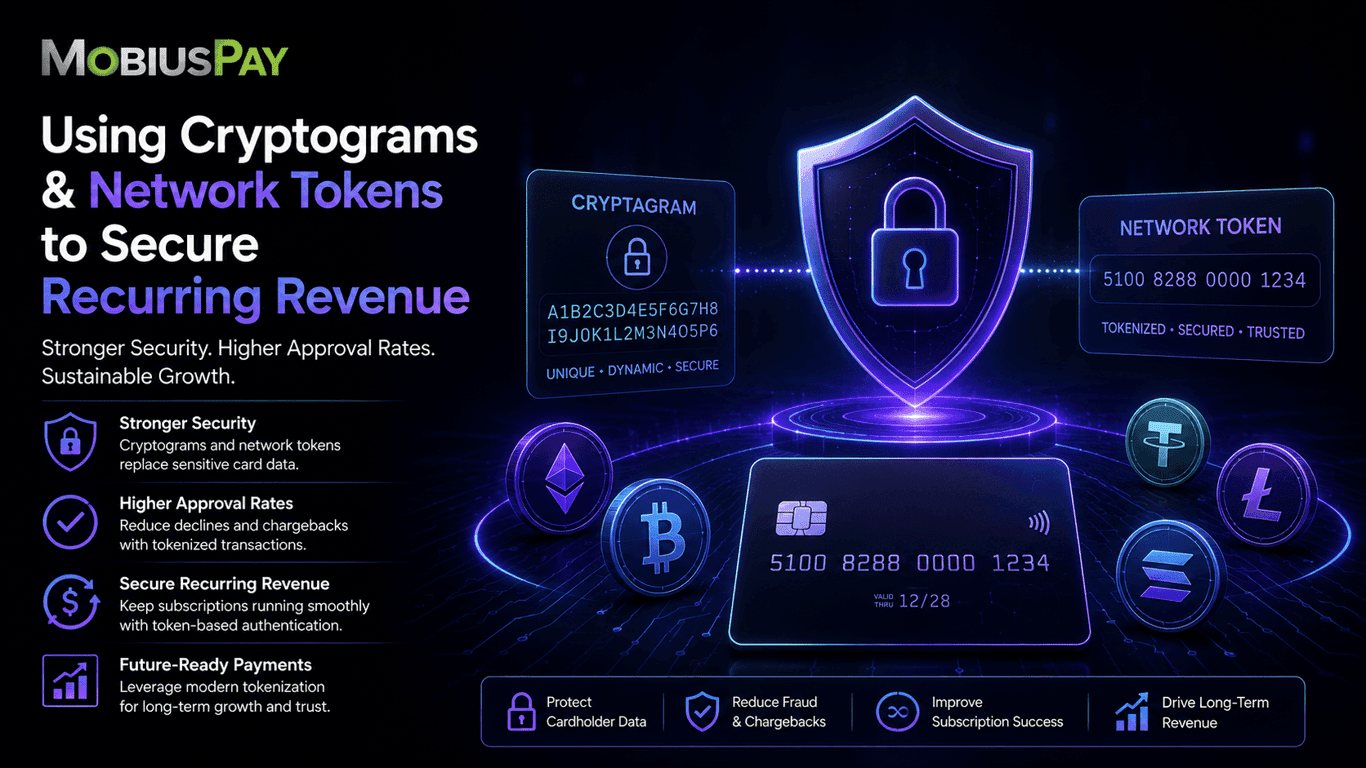
Using Cryptograms & Network Tokens to Secure Recurring Revenue
How cryptograms work and why they are essential for stabilizing your recurring billing.

OPPORTUNITIES FOR STORED CREDIT CARD CREDENTIALS
Are you aware of how VISA interprets and processes recurring transactions relating to stored credentials.If not, then this is the article for you!