
What Is Considered a High-Risk Merchant?
You applied for a merchant account, waited a week, and got a one-line rejection. Or you were processing fine right up until a provider froze your funds and closed your account with almost no explanation. Somewhere in that process your business got labeled high-risk, and nobody told you what that means or how to fix it. Well, there’s some good news on the way - we’re going to clear things up and give you some next steps.
Our guide breaks down what a high-risk merchant actually is, what pushes a business into that category, and what to do about it so you can keep accepting payments.
(Hint: You’re gonna be fine, but you should keep reading)
Key Takeaways
A high-risk merchant is a business banks see as more likely to bring chargebacks, fraud, or legal exposure. The label affects approval, pricing, and monitoring, not whether your business is legitimate.
It comes down to a mix of factors: your industry and merchant category code, chargeback rate, business model, where you sell, credit history, and any past terminations.
Some industries are almost always high-risk, including adult, CBD and cannabis, gambling, forex and crypto, nutraceuticals, travel, and subscriptions.
Being high-risk usually means higher fees, closer monitoring, and reserves, and mainstream providers like Stripe, Square, and PayPal may freeze or close your account.
You can still accept cards. A specialized high-risk processor underwrites you properly up front and keeps your payments running.
What a high-risk merchant actually is
A high-risk merchant is a business that banks and payment processors consider more likely to generate chargebacks, fraud, or financial and legal exposure. That single label decides whether you get approved to accept cards, how much you pay to process, and how closely your account gets monitored once it is open.
It is a risk assessment, not a verdict on whether your business is legitimate. Plenty of profitable, well-run companies are high-risk.
It simply means the acquiring bank sees more that could go wrong, so it wants more protection before it says yes. If you want the full picture, our ultimate guide to high-risk merchant accounts covers how these accounts are underwritten and priced.
What makes a business high-risk
No single factor decides it. Processors weigh several things together, and any one of them can tip you into the high-risk bucket.
Your industry. Some categories carry a high-risk merchant category code (MCC) by default: adult, CBD and cannabis, firearms, nutraceuticals, gambling, forex, travel, and more.
Chargeback history. A chargeback ratio creeping toward or past 1 percent signals trouble to acquiring banks and can trigger card-network monitoring programs. Getting ahead of that is what chargeback prevention is built for.
Business model. Recurring billing, free trials, high average tickets, and future delivery (booking now, delivering later) all raise the odds of disputes.
Where you sell. Card-not-present, international, and multi-currency sales are harder to verify and easier to dispute.
Financial profile. Poor personal or business credit, thin history, or being a brand-new company gives the bank less to trust.
Reputation and compliance. Prior account terminations or placement on the Mastercard MATCH list can flag you the moment you apply.
If several of these apply at once, expect to be treated as high-risk no matter how healthy your revenue looks.
Industries that are almost always high-risk
Some verticals are treated as high-risk across the board. Adult entertainment, CBD and hemp, cannabis, online gambling and sports betting, nutraceuticals, credit repair, debt collection, forex and crypto, travel, tech support, and subscription businesses all tend to land here.
If you operate in one of these spaces, the answer is not to disguise what you do. Misrepresenting your business type on an application is one of the fastest ways to get terminated and MATCH-listed. The answer is to work with a processor built for your category from day one.
Why the label matters
Being classified as high-risk changes three things.
You will usually pay higher processing rates, because the bank is pricing in the added risk.
You will face closer monitoring, including reserves or rolling holds on a portion of your funds.
And you are more exposed to sudden freezes if an automated system decides your numbers look off.
That last point is why mainstream, automated providers like Stripe, Square, and PayPal are a poor fit for high-risk businesses. They approve fast and shut down just as fast, often with your money still inside. A specialized processor underwrites you properly up front and manages risk with you instead of pulling the plug at the first sign of trouble.
What to do if your business is high-risk
High-risk does not mean you cannot accept cards. It means you need the right partner.
A specialized high-risk processor prices for the real risk, builds in protections like chargeback tools and redundancy, and gives you a human to call when something breaks.
You may pay more than a standard retail shop, but you get something more valuable in return: payment processing that keeps running.
Come to the application prepared. Have your formation documents, processing history, and a clear description of your business ready, and be honest about your model. Good preparation is often the difference between an approval and a decline.
How banks decide: low-risk versus high-risk
It helps to see the contrast. A low-risk merchant is usually an established business with a simple model: steady sales, small ticket sizes, in-person or well-understood online transactions, and a clean chargeback record. Picture a local cafe or a clothing boutique. Banks approve these quickly and price them cheaply because very little tends to go wrong.
A high-risk merchant crosses one or more of those lines. Maybe the tickets are large, the billing recurs, the sales are international, the industry is regulated, or the chargeback rate runs hot.
None of that makes the business bad. It makes the outcome harder to predict, and banks price and monitor for that uncertainty. Knowing which side of each line you fall on tells you what to expect before you ever fill out an application.
Frequently asked questions
Is being a high-risk merchant bad for my business?
No. It is a classification that affects pricing and monitoring, not a judgment on your legitimacy. Many stable, profitable companies operate as high-risk merchants every day.
Can I avoid being labeled high-risk?
Sometimes you can lower your risk profile by reducing chargebacks and tightening your billing, but if your industry carries a high-risk MCC, you will be classified that way regardless. The goal is to manage it, not hide it.
How much more does high-risk processing cost?
It varies by industry and risk profile, but high-risk rates typically run above standard retail pricing. The exact number depends on your volume, chargeback history, and category, which is why a tailored quote beats any advertised rate.
How do I get approved for a high-risk merchant account?
Apply through a processor that specializes in your industry, submit complete documentation, and be transparent about your business. Our payment processing team can walk you through what underwriting will want to see.
Next step
If you have been declined, frozen, or told you are too risky, that is exactly what MobiusPay was built for. With over a century of combined experience in banking and payment processing, our team knows how to get high-risk businesses approved and keep them running. Get a personalized analysis and we will find the solution that fits your business.
Related Articles
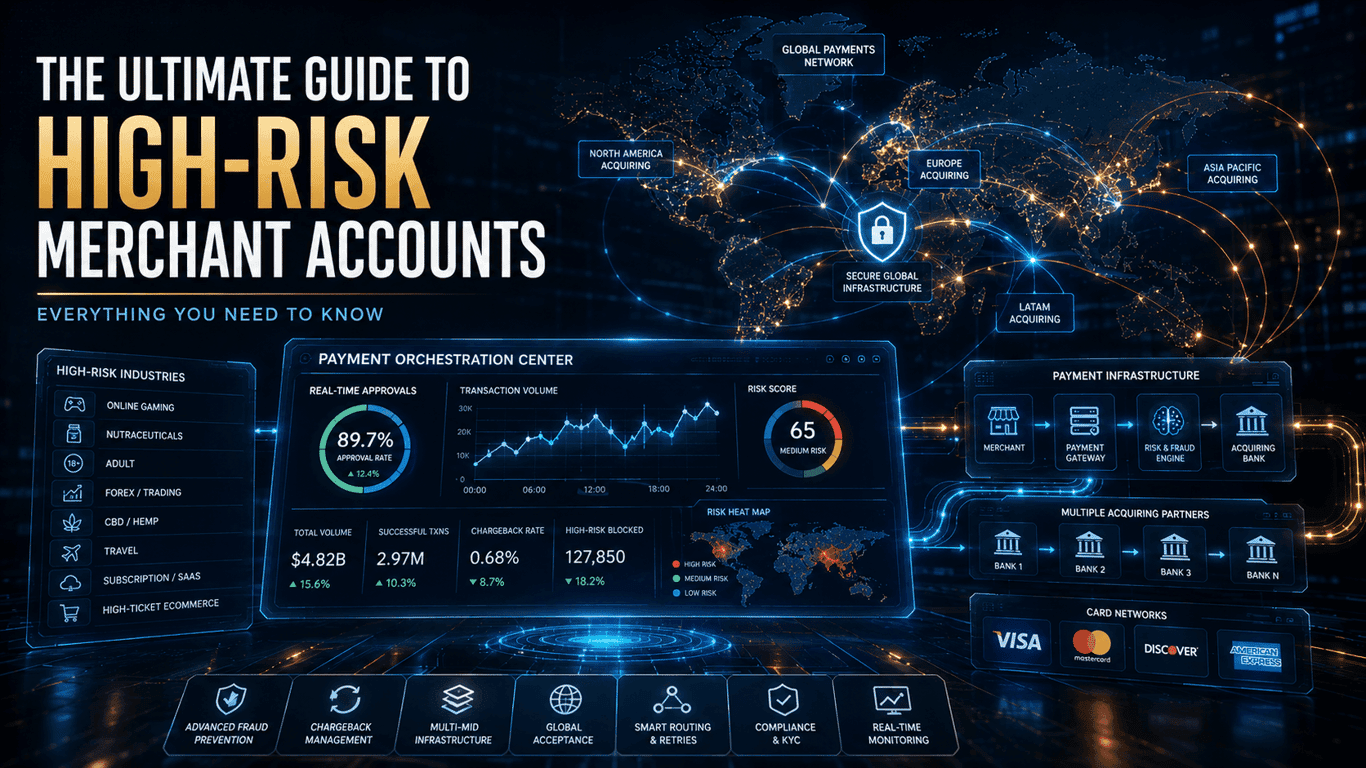
The Ultimate Guide to High-Risk Merchant Accounts: Everything You Need to Know
Businesses need payment processing solutions that can handle the increased risk of chargebacks.
Why Online Dating Is Considered High-Risk for Payment Processing
Dating platforms face chargebacks, fraud, and card network scrutiny. Learn why online dating is high risk and how to keep your payments running.
How to Get an Adult Merchant Account: Requirements & Setup Process
Need an adult merchant account? Learn the approval process, required documents, website compliance, fees, and tips to keep your account active.