
What Is Friendly Fraud, and How Do You Prevent It?
Friendly fraud occurs when a real customer disputes a legitimate purchase, keeps the product, and gets their money back anyway.
The card networks have a less charming name for it: first-party misuse. Visa uses that term in its Compelling Evidence 3.0 merchant guidance, and the shift in language matters, because "friendly" makes it sound like a misunderstanding rather than a chargeback that costs you the sale, the goods, and a fee on top.
There are three stages where you can stop it. You can prevent the dispute from ever forming, deflect it before it hardens into a chargeback, and fight the ones that still happen by submitting evidence under Visa CE 3.0.
Most merchants only work on the third stage, which is the hardest and most expensive. Let's walk through all three.
Friendly Fraud vs. Real Fraud vs. Chargeback Fraud
First, let’s get the definitions straight. A chargeback is a payment reversal that a customer requests through their own bank rather than asking you for a refund. The bank withdraws the money from your account while it sorts out who was right.
Now, the part that people often get wrong: “friendly fraud" and "chargeback fraud" are related, but they are not identical.
Criminal fraud | Chargeback fraud | Friendly fraud / first-party misuse | |
Who made the purchase | A thief using stolen card data | The real cardholder | The real cardholder |
Intent behind the dispute | The cardholder is a genuine victim | Any illegitimate dispute of a legitimate charge, on purpose or by mistake | The cardholder disputes their own real purchase |
Typical example | Card details bought off a forum and used at checkout | Umbrella term covering every case below | "I never ordered this" after the box arrived |
Friendly fraud is a type of chargeback fraud. It is the flavor where the person filing the dispute is the same person who tapped "buy." In the case of true fraud, the cardholder was genuinely robbed, and the dispute is legitimate.
Screening tools may stop thieves. They can do very little against a customer who passed every check, paid happily, and changed their mind six weeks later.
Why Do Customers Dispute Charges?
Some people know exactly what they are doing. A share of first-party misuse is deliberate:
The customer knows the refund window closed.
They know the terms.
They call the bank anyway, say the charge was unauthorized, and count on the issuer siding with them.
Digital goods, memberships, and anything with no shipment to track are the easiest targets, since there is no package sitting on a porch to argue about.
Refund abuse works a little differently. There, the customer claims the order never arrived, even though it did, and is chasing a refund rather than a fraud reversal.
Honest confusion is another major source of first-party misuse, and it is also the cheaper one to fix. Intent is often absent.
You will often see three patterns:
The descriptor does not match. The statement shows a holding company the customer has never heard of, so they assume the worst.
A subscription they don’t remember. Eleven months after signup, the customer forgot the account existed.
Someone else used the card. A spouse, a roommate, or a kid bought something, and the person reading the statement does not recognize the charge.
None of those customers want to steal from you. They just could not connect a line on a bank statement to something they wanted.
Why Friendly Fraud Costs More Than the Sale
One disputed order hits you three ways:
The product or service: You already paid to make it or fulfill it.
The payment: The issuer pulls it directly from your account.
The dispute fee: You pay it no matter how the case ends.
Add it up, and a single chargeback can cost several times the margin on that order.
And that’s not all. Every chargeback counts against your dispute ratio. Stack enough of them, and you cross a network chargeback threshold. That puts you in a monitoring program with remediation deadlines and extra fees. In severe cases, you lose the merchant account.
That is the real risk. A run of friendly fraud does not just drain this month's revenue. It puts your ability to accept cards at all on the table.
How to Prevent Friendly Fraud?
Prevention is unglamorous, but it works. Here is where to spend your effort, roughly in order of return.
The fix | What it stops |
Clear billing descriptor | "I don't recognize this charge" |
Easy refunds and cancellations | Customers who call the bank instead of you |
AVS, CVV, and order records | Criminal fraud with weak evidence |
3D Secure | Fraud-coded disputes only |
Renewal reminders | Forgotten subscription charges |
Fix Your Billing Descriptor First
The cheapest fix in payments, and the one most merchants skip. Your descriptor is the text a customer sees on their bank statement.
Bad: HLDG SVC 8829
Good: COASTALGEAR 888-555-0199
If your store is CoastalGear and the statement says HLDG SVC 8829, you manufactured a dispute out of nothing. Match each descriptor to the brand name people actually bought from, and add a support number where the format allows.
Make Refunds and Cancellations Easy to Find
Every self-service cancellation is a chargeback that never happened. Think about the two paths a frustrated customer can take:
The bank route costs you the sale, a dispute fee, and a point against your ratio.
The refund route costs you the sale. Nothing else.
If canceling requires an email, a wait, and a follow-up, plenty of people pick the faster route. So publish your refund policy before checkout, not three clicks deep, and answer support messages quickly.
Keep Records, and Run AVS and CVV Checks
Two quick definitions:
AVS (Address Verification Service) compares the billing address a customer enters with what their issuing bank has on file.
CVV is the 3- or 4-digit code on the card that confirms the buyer is in possession of it.
Both belong in your fraud detection setup by default. Run them, then store the results.
Store these too:
Shipping and delivery confirmations
IP addresses
Device data
Login timestamps
Signed terms at checkout
This data does double duty. It screens out thieves and becomes your evidence file if a dispute lands eight months from now.
Turn on 3D Secure Where it Fits
3D Secure adds an authentication step between your checkout and the issuing bank. When a transaction clears, fraud-related chargeback liability generally shifts to the issuer rather than remaining with you.
Read that carefully, because the scope is narrow.
What it covers: fraud-coded disputes.
What it does not cover: a customer who authenticated, paid, received the goods, then claimed the order never arrived. Or the forgotten renewal.
Network rules change, so confirm the current program terms with your processor before you lean on it.
Remind Subscribers Before You Bill Them
For anyone running recurring billing, this is the highest-return step on the list.
Send a notice a few days ahead of the charge. Name the product plainly. Show the amount. Include a one-click cancellation link.
Some people will cancel. Fewer will dispute. Here is the trade:
A voluntary cancellation costs you a customer.
A chargeback costs you the customer, the money, the fee, and a mark against your ratio.
How to Stop Disputes Before They Turn Into Chargebacks
Between the moment a customer calls their bank and the moment a formal chargeback hits your account, there is a window. Pre-dispute tools work during that window.
Tool | What it does | When it fires |
Verifi Order Insight | Pushes your transaction details to the issuer in real time, so the bank can show the cardholder the merchant name, order, and items | While the customer is still on the phone |
RDR (Rapid Dispute Resolution) | Applies refund rules you set in advance and resolves qualifying cases automatically | Before a dispute is ever filed |
Ethoca Alerts | Notifies you that a dispute is forming, so you can refund it yourself | After the complaint, before the chargeback |
Different networks and vendors use different methods, but the goal is the same: step in early, resolve the issue directly, and avoid a formal dispute.
Plenty of "I don't recognize this charge" calls end the second the bank can show the customer what they bought.
The payoff goes past the individual order. Per Visa's Acquirer Monitoring Program materials, disputes resolved through these pre-dispute channels are excluded from the VAMP ratio. A deflected dispute never counts against your standing with the network.
That gap compounds over a year of orders.
Pre-dispute tools run through network integrations and vendor relationships most merchants do not hold directly. You cannot sign up for them the way you would buy software. It starts as a conversation with your processor.
How to Fight Friendly Fraud You Could Not Prevent
Some disputes get through. Then you have a decision: accept the loss or challenge it.
Fighting it is called representment, which means submitting evidence to the issuer to argue the charge was legitimate and should stand. What counts as evidence:
Evidence you submit | What it proves |
AVS and CVV match results | The buyer had the real card and knew the billing address |
Shipping and delivery confirmation | The goods arrived, and where |
Login history and account activity | The cardholder used what they bought |
IP address and device fingerprint | The disputed order came from the customer's own device |
Checkout terms acceptance | They agreed to your refund and cancellation policy |
Support tickets or chat logs | They engaged with the product and raised no complaint |
Pull as many rows as you can for a single case. One data point rarely wins. A stack of them usually does.
Visa Compelling Evidence 3.0
If the dispute is a Visa fraud-coded chargeback (reason code 10.4), Compelling Evidence 3.0 lets you win it by proving the same cardholder bought from you before and did not dispute those charges. It needs at least two prior undisputed transactions from that customer, sharing specific data points such as device ID or IP address, and it applies only to 10.4, not to goods-not-received, cancelled subscriptions, or quality complaints. A qualifying win is also excluded from your VAMP ratio, so it protects more than the single transaction.
The exact qualifying rules, the data you have to be capturing beforehand, and who actually submits the case are in our full guide to Compelling Evidence 3.0.
Start logging that data today if you haven't, because you cannot collect it once the dispute arrives. When you are ready to put the file to work, dispute resolution and chargeback representment is where you prepare and submit the evidence.
How MobiusPay Helps You Reduce Friendly Fraud
Look back at those three stages, and you will notice they demand different things. Prevention is configuration work. Deflection needs network-level tooling. Representment needs someone who reads dispute codes for a living and can assemble a qualifying evidence file inside the response deadline.
MobiusPay has processed payments since 2010 for merchants other banks turn away, and the team covers all three: descriptor and screening setup on the front end, pre-dispute alert management in the middle, and evidence-backed representment when a chargeback lands.
That can be especially important for subscription businesses and card-not-present verticals, where friendly fraud can put pressure on an already-important dispute ratio.
Get started today or contact us for more information.
Related Articles

What is Friendly Credit Card Fraud, & How Can it Be Prevented?
Friendly fraud is rising and driving costly chargebacks. Learn how to prevent disputes, protect revenue, and keep your merchant account secure.
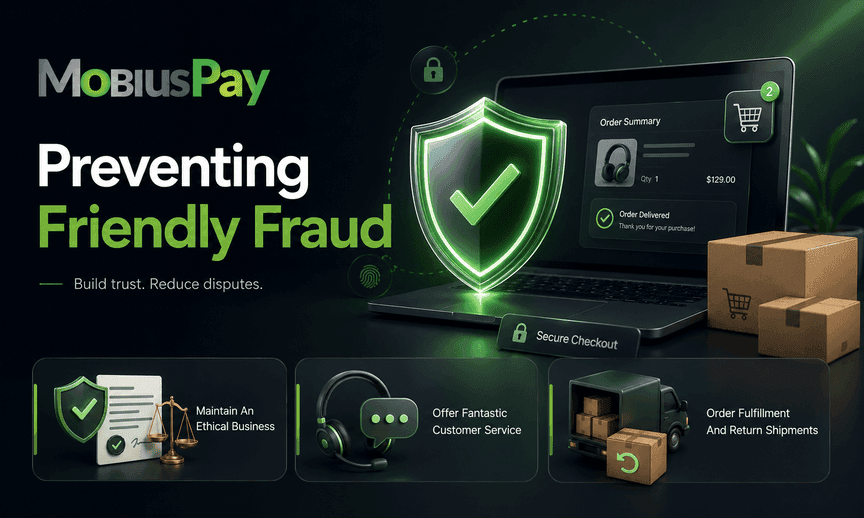
Preventing Friendly Fraud
There are different types of reasons chargebacks occur. Learn why chargebacks occur and ways to prevent them here, and protect your business.
How to Reduce Chargebacks for Gambling Merchants
How to reduce gambling chargebacks with proven prevention strategies, KYC, 3D Secure, fraud controls, and dispute management best practices.